April 16, 2026
·PostWe Are a Software 2.0 Company
Our broader vision—encompassing crypto and AI
Modular Cloud was founded in 2022 to create developer tooling for the burgeoning Celestia ecosystem. Our first product was a block explorer, but we didn’t like the business model required to sustain it. A block explorer company has three paths:
Charge a few major blockchains a large fee to maintain custom block explorers. This would make us more of a software consulting company without a scalable revenue model. In the age of AI, it’s debatable that such a service is even needed. To the extent that it is, there isn’t much money it.
Launch a pointless token. We never even considered this.
Attempt to position our centralized infrastructure as a lynchpin for an otherwise open ecosystem. Similarly to #2, this is contrary to our values. Short-term this could work by enhancing DX, but long-term this would be a net negative to the industry.
And so, after working to provide a block explorer service to a large variety of blockchains, including EVM, SVM, Cosmos, Move chains and more, we decided to pivot.
The realization we came to through this process is that blockchain developers shouldn’t use blockchain-specific tools, they should be empowered to use industry standard tools.
Instead of using web3 frontend libraries to connect to blockchain node RPCs interacting with smart contracts written in specialized languages compiled to blockchain-specific virtual machines, developer should be able use Next.js or whatever else is the industry standard for developing apps. They, then, don’t need a custom block explorer that shows the app’s state as it is represented in a blockchain’s VM—instead they can store the app’s state in an industry standard tool like PostgreSQL (PG), and visualize it using industry standard PG visualization tools.
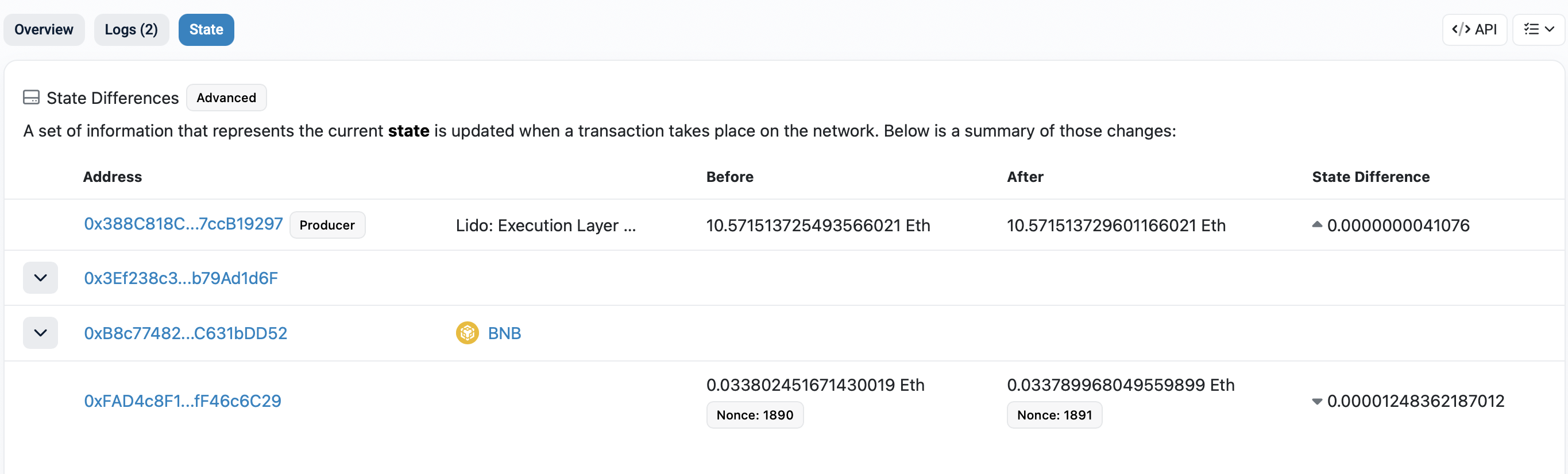
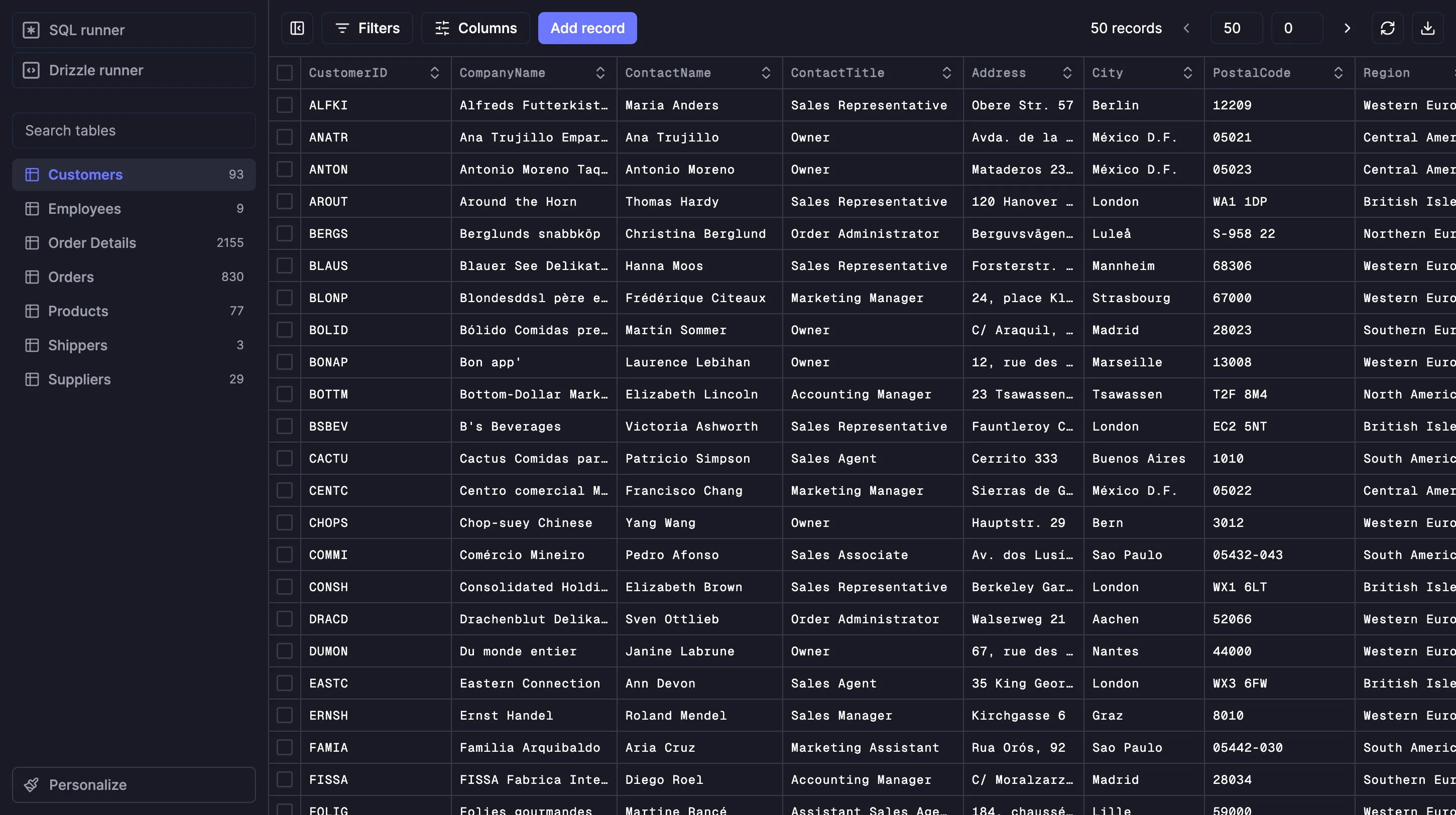
And so, Chopin Framework was born—an adapter that converts regular web apps to run on top of blockchains.
We will discuss more about Chopin Framework in other posts. But here our plan is to enumerate Modular Cloud’s mission and values as a company.
A Software 2.0 Company

Although pivoting from crypto to AI is a meme at this point, we would argue that it’s no coincidence that they both have been two of the most hyped categories of tech over the past decade. Both are two wings of the same bird.
“Crypto is Libertarian, AI is Communist” ~ Peter Thiel
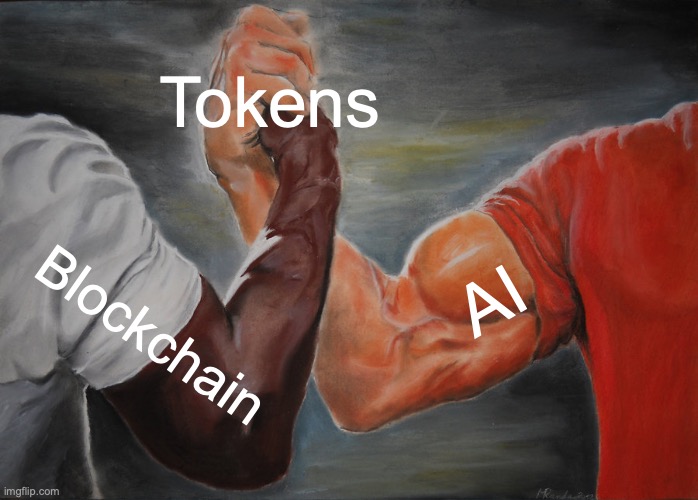
Jokes and hot takes aside, there is a very real way in which this is true. Both crypto and AI are a new form of software, called Software 2.0.
What is Software 2.0?
In his legendary November 2017 blog post, Andrej Karpathy coined the term Software 2.0.
Around this time, the landmark paper Attention Is All You Need was published—which later became the basis for the LLM revolution. Crypto was also just finishing up its first supercycle and one year later Mustafa Al-Bassam and Vitalik Buterin would publish their paper on Fraud and Data Availability Proofs, an important contribution to blockchain scaling that would later provide the basis for Modular Cloud’s big bet on crypto.
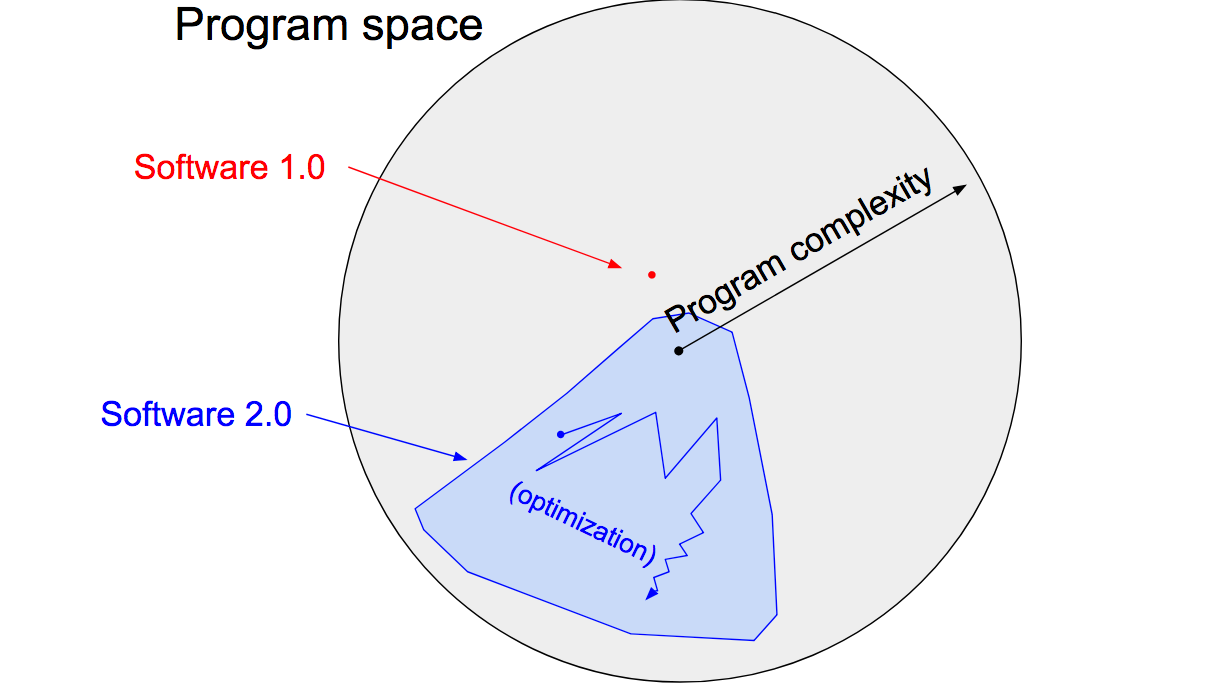
The idea that Karpathy put forth was ingenious. He first drew a comparison between traditional software (Software 1.0) and Software 2.0. Software 1.0 is written by hand, whereas Software 2.0 is discovered by an automated process that could create much more complex and powerful software than human could ever write.
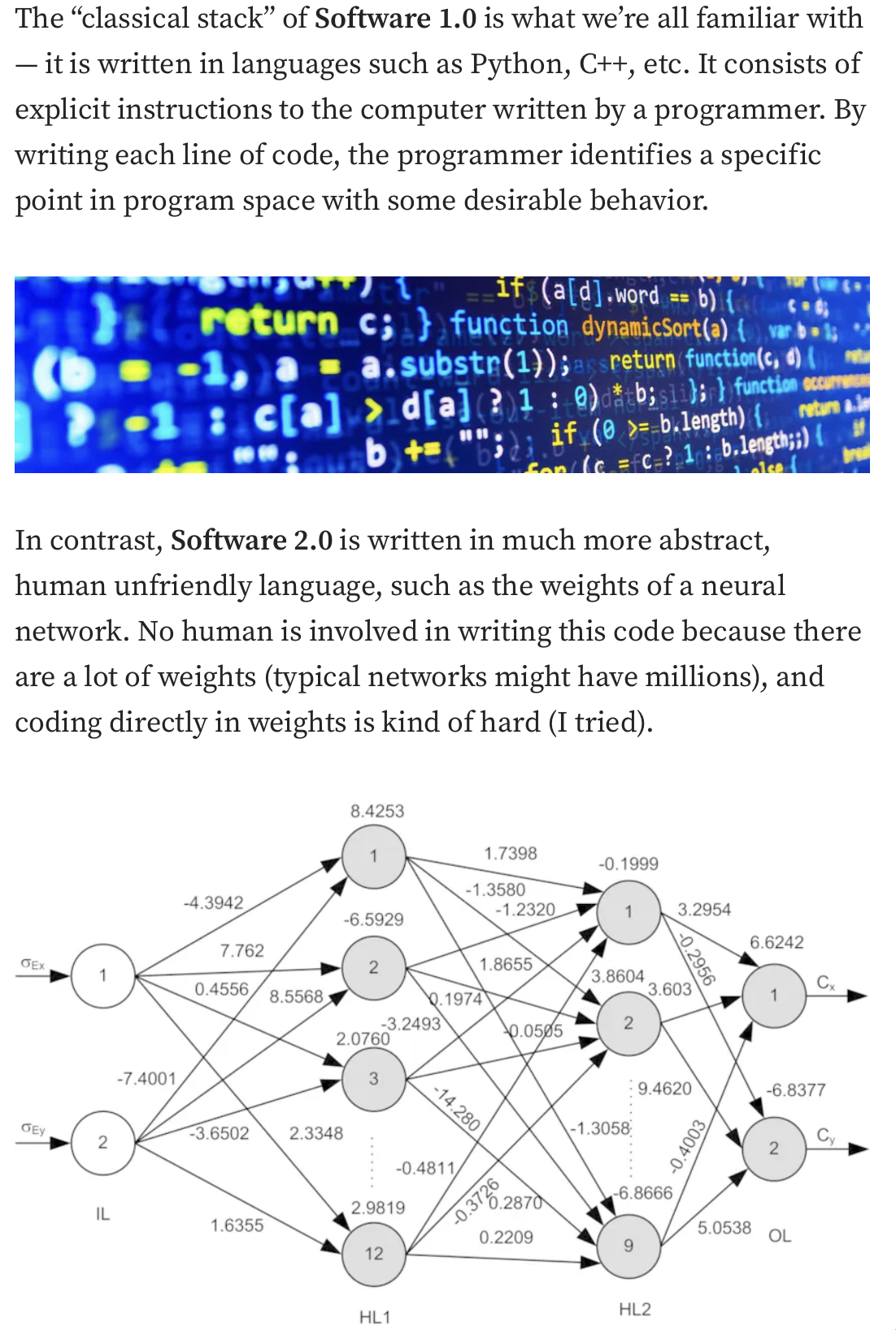
He visualized it like this.
To give a concrete example of how Software 2.0 works, he cited an example from his work at Tesla.
It would be impossible to code all of the rules for self-driving cars by hand. However, machine learning provides a method to create software that does just that. At Tesla, he led a team that trained a neural network to drive a car. A neural network is, at the end of the day, is just a piece of software. But its implementation is discovered through a process of optimization, which shifts the implementation incrementally during each training cycle to get closer and closer to the desired implementation.
In the space of all possible programs (depicted in the circle above), the Software 2.0 process systematically finds the point in that program space has the developer’s desired behavior. When constructing Software 2.0, you are not contributing to that implementation directly, but rather architecting an automated search process that discovers a working implementation.
To draw a rough analogy, Software 1.0 is like artisanally assembling a product by hand. Software 2.0 is like designing a factory for building a product. Ultimately, a factory will have much great production capacity than what one person can do themselves.
Vibecoding is Software 2.0
We have another write-up planned on this specific topic, so we won’t go too deep on this point. With that said, Karpathy has called vibecoding Software 3.0. Respectfully, we disagree.
Properly vibecoding software requires giving the AI success criteria it can check its work against. This could entail running a ralph loop that continuously checks its work against a spec. Or it could be providing clear acceptance criteria to an agent like Claude Code, which will compile and test its code prior to halting.
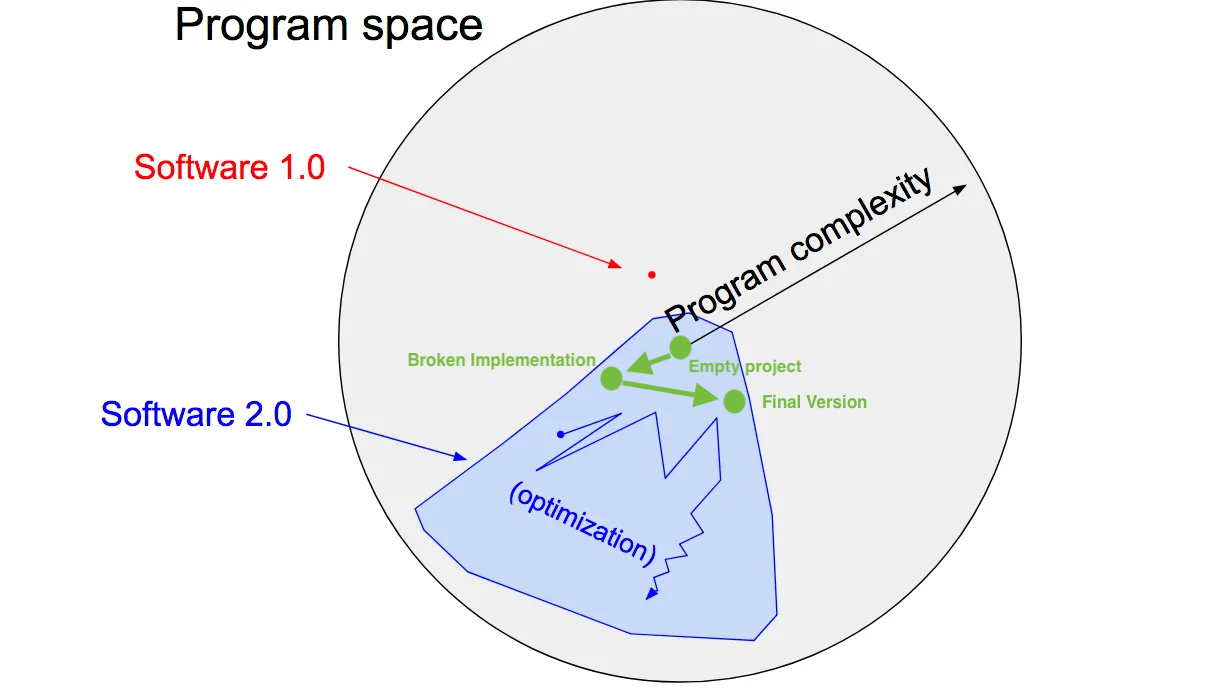
As a basic example, let’s say you want a functioning Hello World program written in Rust. If you ask Claude Code to build it, it will write the code and then attempt to compile it. The models are so good that I will almost certainly do it properly in one-shot, but if compilation were to fail it would attempt to fix the errors and then try again.
Building off of his original visualization. Imagine the initial state of the program as being located in the center of the circle, then the first implementation would be a point further from the center. After the failed compilation attempt, it would alter the implementation again and find yet another point in program space.
Web 3.0 is Software 2.0
Back in 2022, Modular Cloud’s founder gave a talk at Modular Summit about this topic.
He argued that blockchains run a similar optimization process to neural networks—using market incentives instead of gradient descent and back propagation. In other words, instead of minimizing loss, nodes in a blockchains network are maximizing profit.
By creating a single node implementation that runs on every participant’s computer, emergent behaviors arise as participants seek to accumulate tokens in the network.
For example, a single Bitcoin node is not highly available or particularly useful. However, the incentives drive miners to contribute hash power based on market dynamics and ultimately create a highly available and robust network for processing payments.
Ethereum, by itself, doesn’t have much functionality. But Ether’s liquidity and Ethereum security incentivize developers to create smart contracts that encode more useful behavior onto the platform.
These examples are subtle, but sometimes the searching process is more overt.
Automated Market Makers allow users to swap tokens without a central limit order book. Facilitating transfers between anyone who wants to directly swap 2 things is very difficult, in fact that’s why money overtook barter. But AMMs solved this by incentivizing liquidity providers (LPs) to participate in their network. LPs are actively finding ways to allocate funds to these markets in order to make a profit—which ultimately is what makes AMMs work.
Block building is not a straightforward process. There are large amounts of transactions incoming at any moment, and a blockchain needs to determine which order they should be in. Cloud and Internet providers face the same challenges when trying to prioritize traffic for customers. However, modern block building systems incentivize participants to search for the most efficient and profitable way to order transactions in blocks—which overall improves the efficiency of the network.
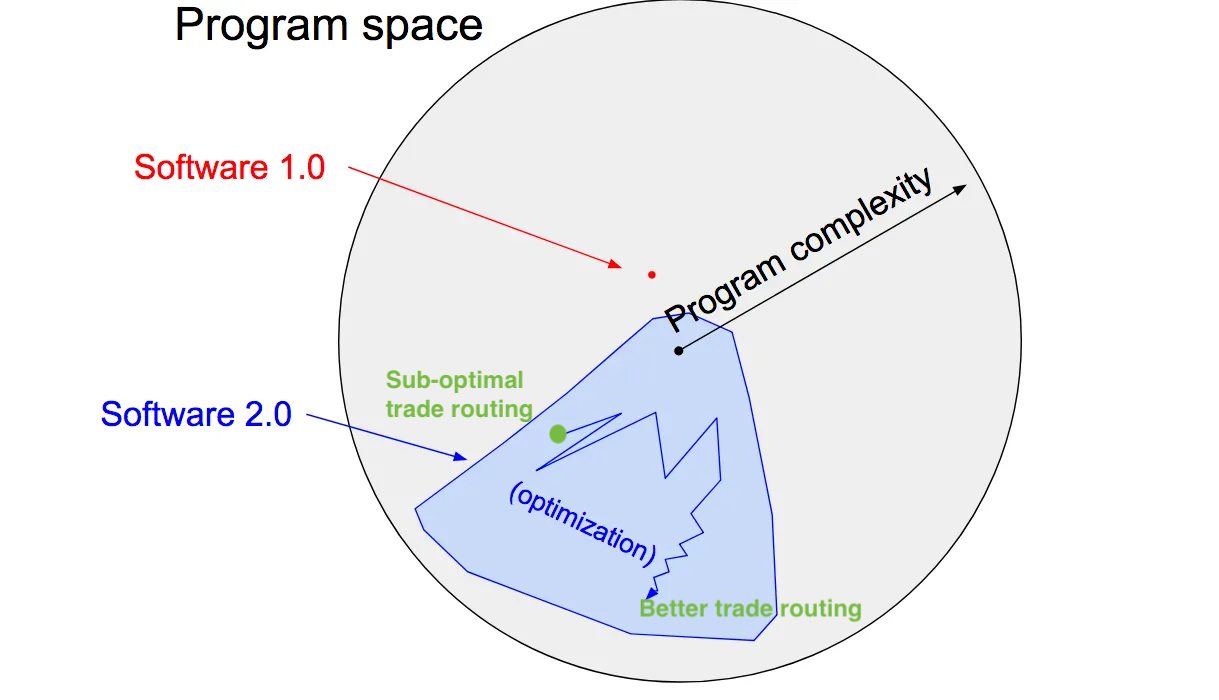
Intents make complex transactions more efficient. Intent networks have “solvers” that search for the best way to route and fulfill a trade.
Blocks will be built via software. Trades will be routed via software too. The question is what software and how did it get built?
Crypto enables programmers to build “designer markets” that optimize for a certain outcomes. This means that they don’t necessarily need to hard-code the best trade routing algorithm into the protocol, instead they can incentivize a network to provide a superior version of this software through an optimization process.
In other words, they aren’t writing the behavior they want by hand. They are building the system from which these behaviors can emerge. And in doing so, they are able to build systems more complex and efficient than they could have implemented themselves.
This viewpoint was one of the precipitating factors for the creation of Modular Cloud, and remains a core thesis to this day. It just so happens that ChatGPT launched after this talk and Modular Cloud’s founding—and now that agentic software development is as big as it is today, we are officially broadening our focus to encompass both crypto and AI.
Crypto x AI
With all of that theory behind us, we also must acknowledge an important fact: crypto and AI work exceptionally well together.
Crypto is fully verifiable and programmatic. It is a fully and natively digital system, ultimately serving as a backend and infrastructure for user facing systems. All behaviors of crypto protocols are defined by specs and implemented in code.
This just so happens to be exactly the domain in which AI excels.
AI is great at turning specs into code. It does its best work when it can verify and run everything end-to-end.
The extent to which AI fails is the extent to which it cannot check its own work. It does less well if human taste comes into the equation, or if meatspace operations need to be executed.
In fact, if there is anything AI was meant to do, it is to build and audit crypto protocols. After all, the specs, code, infrastructure, and usage data is all open source and publicly available.
At Modular Cloud, we are going to continue building Chopin Framework and other decentralized systems using AI. In doing so, we are attempting to push AI further than it has ever gone. We will also be actively sharing these AI development methods with others and building products around our workflows.
Our Values
Our vision is larger, but our values remain unchanged. If we could distill down everything we believe into two principles here is what they would be:
We stand against corruption. Bitcoin’s original promise is to disrupt government and corporate corruption on Wall Street. We will forever carry that cypherpunk ethos with us. We are building crypto systems that guarantee us a more fair, transparent, human rights respecting (including privacy), and honest world. AI not only accelerates the development of these system, but also democratizes the flow of information.
We stand for global meritocracy. Many people around the world are victims of their circumstances. As a result, so much human potential is wasted. Our goal is to build systems that allow all people to be their best selves and to provide them opportunities according to their true ability. Crypto has a long history of giving financial infrastructure to those who need it most and AI democratizes education and information like nothing ever has in history.
If these values resonate with you, please get in touch.
Subscribe to Modular Cloud
Get our latest posts delivered to your inbox.